REVIEW · MAURITIUS
Ebony Forest Reserve Chamarel: Endemic Birdwatching Guided Tour
The rarest prize here is not a dramatic waterfall or a polished show. It is the chance to see a Pink Pigeon or Echo Parakeet in the wild, two birds found only in Mauritius. The reserve protects six of the island’s nine remaining endemic bird species, so this is a serious conservation outing with a good dose of scenery.
I like the small group of no more than nine people, which gives your guide room to point out calls, feeding spots, and movement in the trees. I also like that binoculars, snacks, and drinks are included, while the museum and bird release aviaries add useful context before you walk into the forest. The main consideration is physical: the route can cover about 6 kilometers, and you need moderate fitness.
Key points
- Rare birds in native forest: Look for Pink Pigeons, Echo Parakeets, Mauritius Kestrels, Paradise Flycatchers, Black Bulbuls, and Grey-white-eyes.
- A small 9-person group: The size suits quiet birdwatching and makes it easier to hear your guide.
- A 3 to 4 hour morning: You meet at 9:00 am and return to the same reserve.
- Walk or take a safari jeep: You can reach parts of the route on foot or by vehicle, but walking gives you more time in the forest.
- Sublime Point with Mauritian snacks: The high viewpoint brings mountain and rugged south-coast scenery into the day.
- A conservation-first visit: The museum, release aviaries, and restoration work explain why the reserve matters.
Why Ebony Forest Is Worth Your Morning

Ebony Forest Reserve Chamarel sits in one of the few parts of Mauritius where several endemic birds still have protected habitat. This is not simply a park where you stroll past labeled trees and hope something flies overhead. The reserve is part of an Important Bird Area listed by BirdLife International, and its work includes restoring native forest and supporting bird releases.
That purpose changes the feel of the outing. You are not only searching for a pretty bird. You are seeing a place built to give rare Mauritian species a better chance of survival. The setting also helps: ebony forest, raised walkways, mountain views, and quieter paths give the morning more variety than a standard garden visit.
The price is about $60.58 per person. For a four-hour guided experience, binocular hire, snacks, drinks, entry activities, and a group capped at nine, I consider that reasonable value if birds are a major reason for your Mauritius visit. It is less compelling if you want a relaxed sightseeing stop with little walking, since the best parts require patience and some physical effort.
More Guided Tours in the world:
- Puffin Cruise with Expert Tour Guide from Reykjavik
★ 4.5 · 636 reviews - 2 Hours Guided Whale and Bird Boat Tour in Bay Bulls
★ 5.0 · 557 reviews - Guided Evening Penguin Viewing Otago Peninsula, Dunedin, New Zealand
★ 5.0 · 471 reviews
The 9:00 am Start at Chamarel
You meet at Ebony Forest Reserve Chamarel at 9:00 am. The activity begins and ends at the reserve, so you should plan your own way there and allow enough time to arrive ready for a morning outdoors. The site is near public transportation, but the supplied information does not promise hotel pickup or private transfers.
Morning is the right time for this kind of outing. The light is still useful for spotting movement in the canopy, and the four-hour schedule leaves room for a slow pace. Birdwatching rarely follows a tidy timetable. One stop may produce several species, while another may give you only a call from deep in the trees.
The small group matters here. With a maximum of nine people, your guide can keep the pace suitable for the group and show you where to look without turning the walk into a noisy procession. You will need to accept that sightings are never guaranteed. Even in a protected forest, rare birds may stay hidden, move quickly, or feed out of sight.
Start With the Museum and Release Aviaries
Before heading deeper into the reserve, you make a brief visit to the museum. This gives you a useful introduction to the forest, the endemic species, and the conservation work taking place around you. A film is also part of the opening experience, helping set the scene before you begin looking for birds in the trees.
The release aviaries are a particularly meaningful stop. They offer a chance to see Echo Parakeets and Pink Pigeons connected with the reserve’s protection work, while also giving you a better idea of the birds’ size, color, and behavior. That can help when you later search for them in the wild.
Still, keep your expectations clear. Seeing a bird in or near an aviary is not the same as finding one feeding freely in the forest. The real goal is to use this first stop as preparation, then test your eyes and ears along the trail.
Searching for Six Endemic Species
The reserve is one of the few places in Mauritius where six of the island’s nine remaining endemic birds may be found. Your guide will show you how to scan the forest, listen for calls, and watch feeding areas rather than simply walk with your eyes fixed overhead.
Possible sightings include:
- Pink Pigeon
- Echo Parakeet
- Mauritius Paradise Flycatcher
- Mauritius Black Bulbul, also called the merle
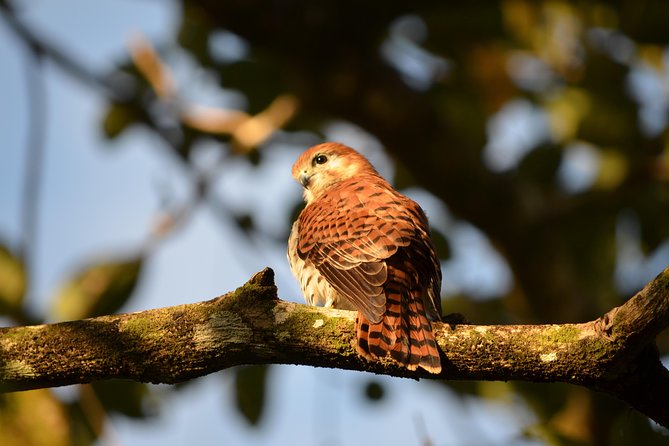
- Mauritius Kestrel
- Grey-white-eye
These are not ordinary park birds. Their restricted range makes each sighting special, but it also means the outing rewards patience more than speed. You could see several species, or only one or two. A reported walk covered five of the seven species being sought, but that should be treated as an excellent result rather than a standard promise.
Your guide also points out plants, butterflies, and other forest details. That is important because the morning does not collapse if a Pink Pigeon refuses to appear. You still learn how the forest functions and why native vegetation matters to its birdlife.
Bring your attention, not just your camera. The supplied binoculars are included, and they are far more useful for quick sightings than trying to frame everything on a phone. A camera is not included, so you should bring your own if photography matters to you.
A few more birding trips around the world worth a look
- Penguin Parade, & Wildlife Encounters Eco Tour from Melbourne
★ 5.0 · 3,774 reviews - Cape Town: Cape of Good Hope & Penguins Day Tour with Pickup
★ 4.7 · 3,362 reviews - Cape Point and Boulder’s Penguins Full Day Tour
★ 5.0 · 3,118 reviews - Cape of Good Hope & Boulder Penguins Full-Day Tour from Cape Town
★ 5.0 · 2,347 reviews
Walking the Forest or Taking the Safari Jeep
The route can be explored on foot or with safari jeeps for some sections. That choice affects the character of the outing. Walking gives you more time to notice quiet bird calls, butterflies, plants, and changes in the forest. It also makes the experience more active and can bring the total distance to around 6 kilometers.
A jeep can reduce the physical demand and help you reach the viewing points more easily. That may suit you if you have limited stamina or want to save energy for birdwatching. The tradeoff is simple: less time walking means less time slowly scanning the habitat where the birds live.
If your fitness allows, I would choose to walk both ways. That advice comes from the nature of the experience itself. Birdwatching depends on being present in the habitat, and a vehicle can carry you past small moments that a guide might otherwise explain. Still, the jeep option is useful, and you should not feel that choosing it makes the tour less worthwhile.
The walk requires moderate physical fitness. The route includes forest paths, boardwalks, and raised sections, with some movement through uneven outdoor terrain likely. The information provided does not promise a fully accessible route, so ask the operator before booking if mobility is a concern.
The Flycatcher Raised Walkway
One of the most distinctive parts of the route is the Flycatcher Raised Walkway. Boardwalks rise into the canopy, offering a different view of the forest than a ground-level trail. You get a chance to look across branches and foliage where canopy birds may feed or move between trees.
The raised walkway also adds a little drama to an otherwise patient activity. You are not just stopping beside a path and waiting. The higher position can open sight lines through the forest, though it cannot guarantee a bird will appear at the perfect distance.
The structure may be a highlight if you enjoy forest walks even when sightings are brief. It gives the tour a clear sense of place and helps you understand the height and density of the restored woodland. Take care to keep your movements slow and your voice low. Sudden noise is not helpful when the group is trying to locate a bird by sound.
Sublime Point and the South Mauritius Views
The route continues to Sublime Point, a viewpoint over the mountains and rugged scenery of southern Mauritius. This is where the experience shifts from close forest observation to a wider view of the island.
You stop here to enjoy Mauritian snacks and a drink. That break matters after a long walk, especially if you have spent the morning standing still, moving carefully, and carrying binoculars. It also gives your guide a natural moment to explain the surrounding mountains and the wild south.
Sublime Point is not only a refreshment stop. It provides a useful contrast to the forest. Down among the trees, you focus on one branch or one call. From the viewpoint, you see the broader setting that makes the reserve feel remote and valuable.
The snacks are a modest inclusion, but a practical one. You do not need to arrange a separate food stop during the four-hour activity. If you have specific dietary needs, the supplied information does not describe the snack selection, so ask ahead rather than assume it will suit you.
What the Guides Add
The guide is central to the value of this tour. A forest can look quiet and empty if you do not know what to listen for or where to search. Your guide explains how to find birds, identifies plants and butterflies, and connects the sightings with the reserve’s restoration work.
The group size gives the guide a better chance to help each person use the binoculars and follow a bird’s movement. That is especially useful if you are new to birdwatching. You do not need to arrive as an expert, but you do need to enjoy slow observation.
A good guide cannot control wildlife. This is worth saying plainly because the tour focuses on rare birds. The guide can improve your odds, explain the habitat, and help you recognize a call. The forest decides what appears.
Who Will Get the Most From This Tour
I would recommend this experience most strongly to birdwatchers, nature photographers with their own equipment, and anyone who wants to understand Mauritius beyond its beaches. It also suits visitors who like conservation projects and are happy to walk several kilometers for a possible sighting.
You do not need specialist birding knowledge. The included binoculars and guided instruction make the outing approachable. Still, you should enjoy quiet stretches and be comfortable with the idea that a rare bird may remain hidden.
Families with older children may find it rewarding, provided everyone can manage moderate physical activity and stay patient. The four-hour length is long for very young children, especially when sightings may take time.
This is not the best choice if you want a guaranteed animal encounter, a short flat walk, or a tour that begins at your hotel. It is also a poor fit if you dislike early starts, though 9:00 am is not unusually early for a morning nature activity.
Practical Value at $60.58
At $60.58, the cost covers more than a guide walking you through trees. You get a small group, binoculars, snacks, drinks, the museum and film, access to the release aviary area, forest restoration context, and stops at the raised walkway and Sublime Point.
The strongest value comes from the guide and the setting. You could visit a forest on your own, but you would miss much of the point if you cannot identify calls, know where to look, or understand the conservation work. The group limit also keeps the experience personal.
The price feels less attractive if you plan to use the jeep for most of the route and are not especially interested in birds. In that case, you may spend four hours for scenery you could find elsewhere in Mauritius. If rare endemic species are high on your list, the cost is easier to justify.
Confirmation is sent within 48 hours of booking, subject to availability. At least two adults are needed for the activity to run. Free cancellation is available up to 24 hours before the start time, while poor weather can lead to a new date or a full refund.
Should You Book the Ebony Forest Birdwatching Tour?
Book it if you want a focused morning with rare Mauritian birds, a small group, and a guide who can make a quiet forest readable. The best reasons are the chance to see Pink Pigeons and Echo Parakeets in the wild, the conservation background, and the mix of forest paths, canopy boardwalks, and Sublime Point views.
Skip it if you need guaranteed sightings or prefer a low-effort attraction. My practical choice would be to walk as much of the route as your fitness allows, use the binoculars rather than relying on a camera, and treat every endemic bird as a bonus. That mindset gives you the most honest and rewarding version of the experience.
FAQ
Where does the tour begin and end?
The tour begins at Ebony Forest Reserve Chamarel, Chamarel, Mauritius, at 9:00 am. It ends back at the same meeting point.
How long does the birdwatching tour last?
Plan on approximately 3 to 4 hours. The overall tour summary lists about four hours.
What birds might I see?
Possible sightings include the Pink Pigeon, Echo Parakeet, Mauritius Paradise Flycatcher, Mauritius Black Bulbul, Mauritius Kestrel, and Grey-white-eye.
Are binoculars and refreshments included?
Yes. Binoculars, snacks, and a drink are included. A camera is not included, so bring your own if you want to take photographs.
How many people can join the tour?
The group has a maximum of nine people. At least two adults are required for the activity to operate.
What happens if the weather is poor?
The experience requires good weather. If it is canceled because of poor weather, you will be offered another date or a full refund.
Newest birding reviews around the world
- Cocora Valley: Route of the Hummingbirds + breakfast & lunch★ 4.9 · 6 reviews
- Bird Watching Tours in Samarkand★ 3.6 · 3 reviews
- Birdwatching in Guatapé with Around 400 Bird Species★ 5.0 · 2 reviews
- Best of Cape Private Tour Cape Point+Penguins+Table Mountain★ 5.0 · 2 reviews
- Barbados: Bird Watching Experience★ 5.0 · 2 reviews
- Birding Medellin with expert bird-watcher (Private)★ 5.0 · 17 reviews
- Bird Creek: Chugach State Park ATV Nature Tour & Hike★ 5.0 · 2 reviews
- Big Island: Native Bird Watching & Hiking Tour★ 5.0 · 5 reviews
Guided, side by side.
Puffin Cruise with Expert Tour Guide from Reykjavik
Read our review →

Guided Evening Penguin Viewing Otago Peninsula, Dunedin, New Zealand
Read our review →

Cape of Good Hope & Penguins Full-Day Guided Tour
Read our review →
Phillip Island Penguin Parade with Expert Local Guide
Read our review →
Guided Kayak Tour to see ponies, birds, dolphins and more
Read our review →