
REVIEW · ITALY
Experience with birds of prey in Tuscany
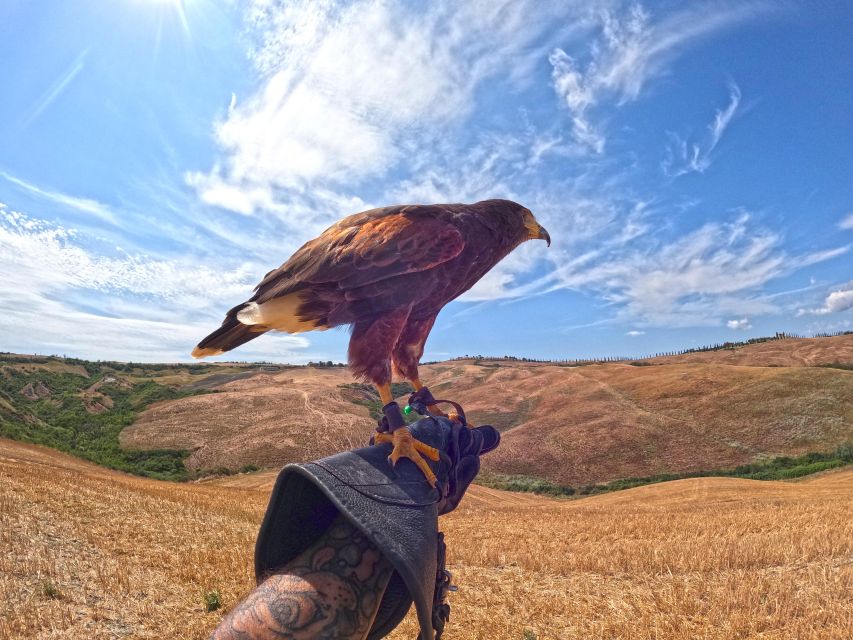
A Harris’s buzzard sweeps low across the open Crete Senesi, then an Asian steppe eagle takes flight. That is the heart of this private falconry experience in Tuscany, where animal trainer Davide explains the birds’ behavior, biology, and training before flying them close to you.
I like two things here: you get genuine contact with the birds rather than a distant display, and the setting is the broad, quiet countryside of Val d’Orcia. Davide and Alessia also make time for questions, photos, and video, which helps you remember more than a few quick snapshots.
The main drawback is the weather. Rain can force a date change, and this is not suitable for children under 10 or people with mobility impairments. At $90.51 per person, it is a specialized outing, so it makes the most sense if birds, animal care, and rural Tuscany are high on your list.
Key points to know before you book
- Two impressive birds fly close by: Meet Brave, a Harris’s buzzard, and Ivy, an Asian steppe eagle.
- Davide leads the teaching: He explains falconry, bird behavior, biology, and the care needed to build trust with a bird of prey.
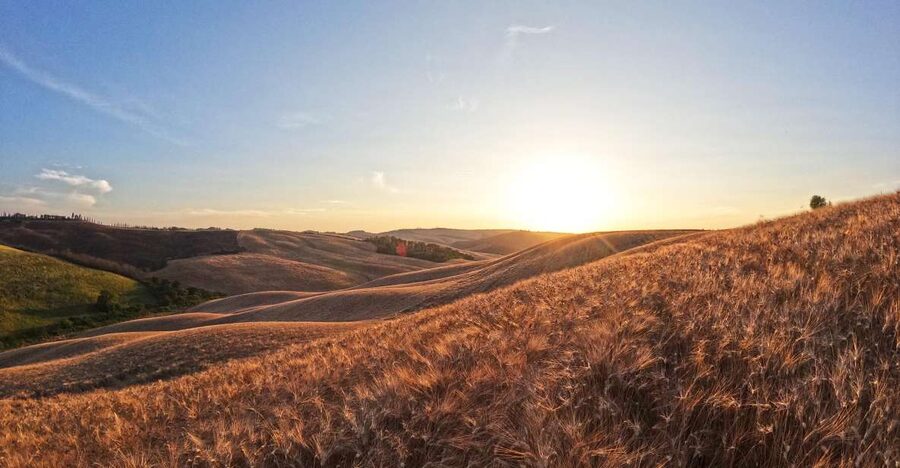
- The setting is part of the experience: The meeting point sits in the Crete Senesi area of Val d’Orcia, with wide panoramic views.
- You get hands-on participation: A falconer glove is provided during the activity.
- Wild birds may appear: Native or migrating species can sometimes be drawn to the birds flying nearby.
- Plan around the sky: The 1.5-hour session runs in suitable weather, generally between 10:00 and 16:00.
Meeting falconry in the Crete Senesi
This is not a long tour with several stops. It is a focused 1.5-hour meeting in the countryside, built around two trained birds and the person who cares for them.
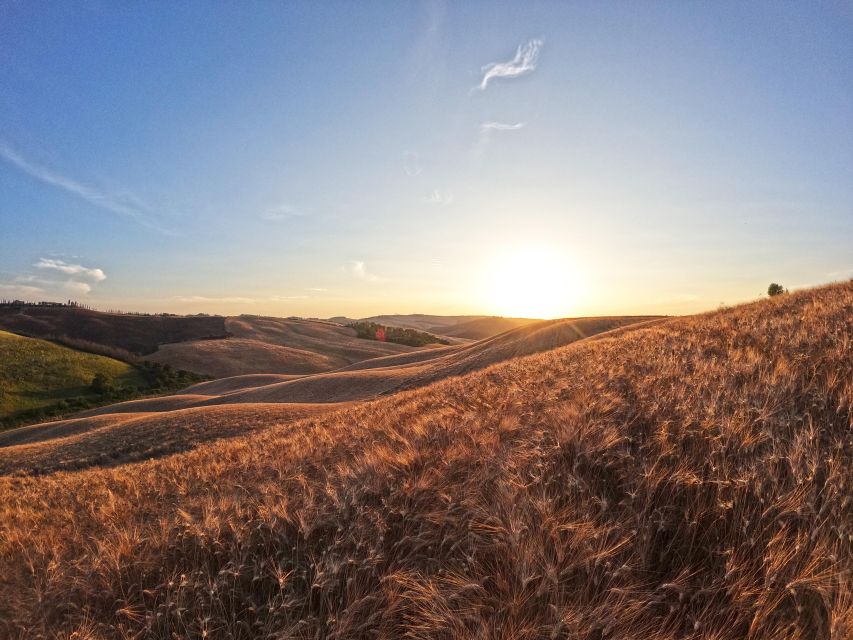
The meeting point is in the Crete Senesi, a celebrated area of rolling earth tones and open fields in central Tuscany. It is part of the wider Val d’Orcia area, where the scenery often feels almost too carefully arranged to be real. Here, the views are not a backdrop you glance at once and forget. They give the bird flights room to unfold.
The exact starting time depends on availability, but sessions generally take place between 10:00 and 16:00. That daytime schedule works well for adding the activity to a day of exploring southern Tuscany. Still, do not treat the time as completely fixed until you check your chosen date. The flight program depends on the weather forecast, and rain can mean changing the booking date.
You meet Davide, the animal trainer, and receive an introduction to the birds and the basic ideas behind falconry. The teaching is available in Italian or English. Since this is a private group, you should have a more personal setting than you would at a large wildlife presentation, with room to ask questions about the animals in front of you.
More Birds of Prey and Falconry in Italy:
- Interactive Educational Course on Birds of Prey
★ 5.0 · 230 reviews - Falconry experience in Tuscany
★ 5.0 · 24 reviews - Discover the fantastic world of birds of prey in the Pollino National Park.
★ 5.0 · 2 reviews
Learning the old art of falconry
Falconry is presented here as an art with more than 4,000 years of history. The point is not just to watch a bird fly, but to understand the partnership between bird and trainer.
Davide explains how birds of prey live, how they behave, and what makes them different from one another. You learn the basic techniques used in falconry, along with the patience and care involved in training. The most interesting part is the relationship itself. A trained raptor is not simply following a set of mechanical commands. The bird and trainer must develop trust and a working routine.
That helps put the flight demonstrations in context. You are not watching a stunt show with feathers. You are seeing the result of steady care, repeated practice, and a close reading of the bird’s behavior.
This teaching also gives the activity more value for adults and older children who want to learn something specific. If you only want a quick photograph with an animal, this may feel more detailed than necessary. If you are curious about how falconry works, the explanation is an important part of the visit.
Brave the Harris’s buzzard takes flight
The first bird you can expect to see is Brave, a Harris’s buzzard. The Harris’s buzzard is known for its intelligence and social behavior, and the session gives you the chance to observe it at close range rather than through a zoo enclosure or from a distant viewing platform.
Davide introduces the bird before the flight. You can expect to hear about its habits and training, then watch it respond as it moves through the open countryside. The wide Crete Senesi setting matters here. There is space for the bird to fly, circle, and return while you remain close enough to notice its movement.
A falconer glove is provided, giving you a more direct link to the demonstration. This is not described as a guaranteed handling session for every participant, so you should think of the glove as part of the guided activity rather than a promise that you will hold every bird. Davide remains present throughout the teaching and flight work.
The close distance is one of the strongest reasons to book this experience. You can pay attention to the bird’s size, flight pattern, and reactions in a way that is hard to appreciate from a standard wildlife viewpoint. It also makes the trainer’s skill easier to understand. You see how much attention goes into keeping the interaction safe and calm.
Ivy the Asian steppe eagle and the second flight
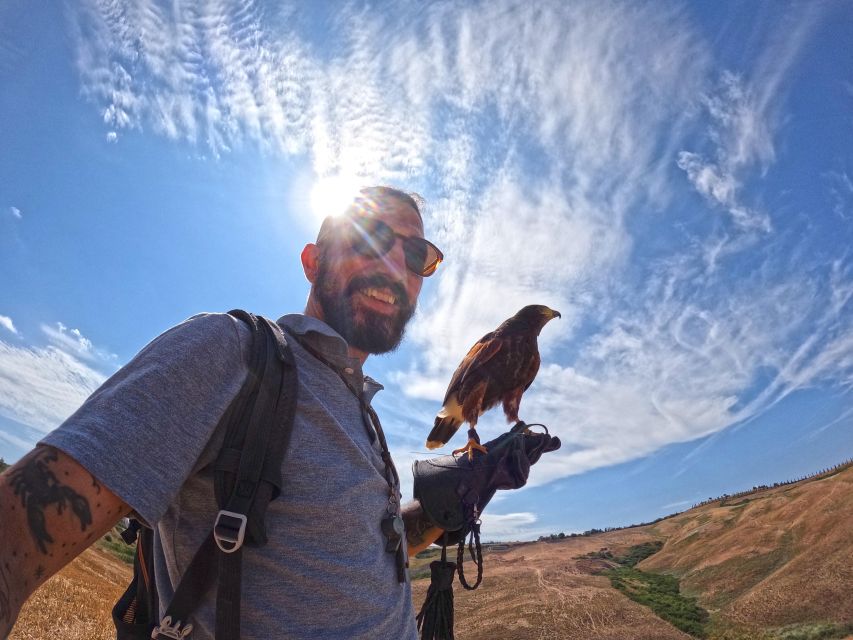
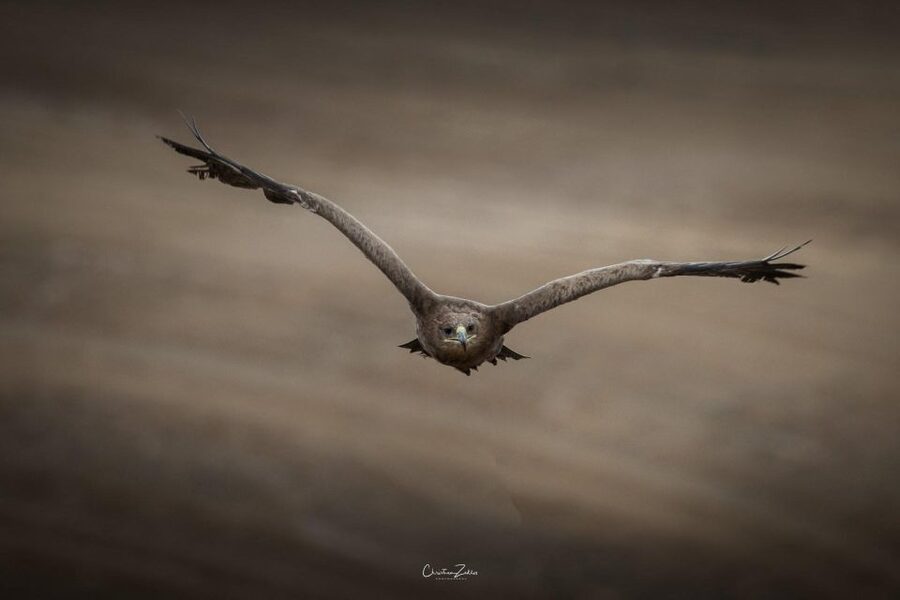
Ivy, an Asian steppe eagle, gives the session a different point of interest. The eagle’s size and presence offer a contrast to Brave, and seeing both birds during one visit lets you compare their appearance and behavior.
The description of the activity identifies Ivy as an Asian steppe eagle, also called a steppe eagle. This is a bird with a strong visual impact, and the open Tuscan countryside gives the flight a natural setting rather than a staged indoor feel.
Davide guides you through the session, explaining what you are seeing and answering questions. One useful detail is that the experience is not limited to a silent display. The teaching covers biology and behavior, so you can connect the eagle’s flight to the animal itself.
The birds are the focus, but the activity is also about responsible care. The people running the session make a point of showing the relationship built over time between trainer and bird. That matters if you are concerned about animal experiences and want to understand how the birds are handled.
There is no promise that every flight will look identical. Birds are living animals, and weather affects the activity. You may see a more active performance on one day and a calmer one on another. That natural element is part of the appeal, but it also means you should arrive with reasonable expectations.
A few more birding trips around Italy worth a look
- Trapani: Salt Pans Sunset Tour and Flamingo Way
★ 4.4 · 252 reviews - Cagliari: Bike Tour in the Flamingo Oasis
★ 4.7 · 141 reviews - Cagliari E-Bike Tour: Gulf, Canals & Flamingos at Molentargius
★ 5.0 · 79 reviews - Cagliari E-Bike Tour: Canals & Flamingos at Molentargius
★ 4.8 · 60 reviews
A short walk with big Tuscan views
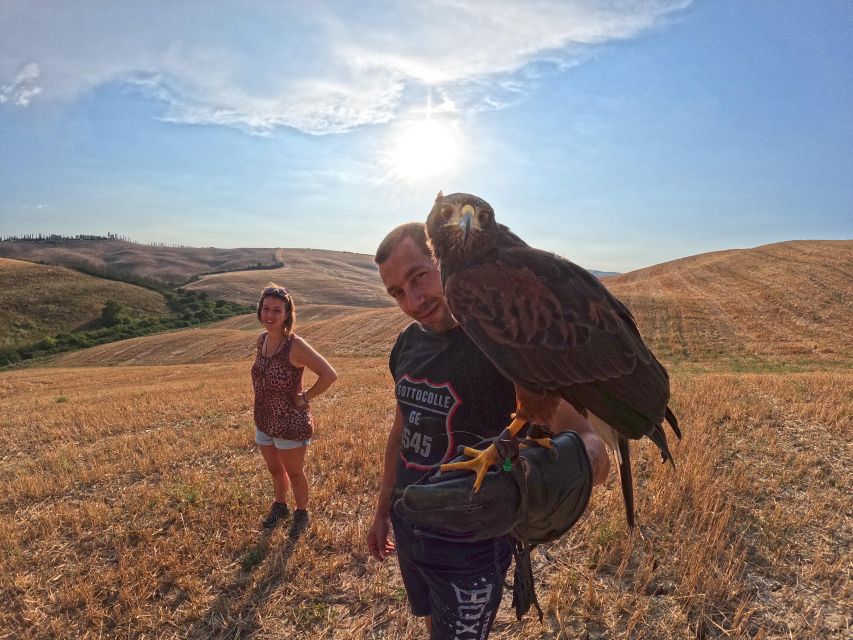
The experience includes a small walking tour in the Crete Senesi. It is described as easy for all ages in the review material, but the activity is officially not suitable for people with mobility impairments. That distinction is worth noting. You should be comfortable walking outdoors for a short period, even though this is not a demanding hike.
The walk helps place the birds in the countryside around them. You are not simply standing in one fixed viewing area while someone brings the animals past you. The movement through the scenery adds a little pace and lets you see the birds work in a more open setting.
The Crete Senesi is especially attractive for people who want more than the famous Tuscan towns. You get panoramic views of the countryside while learning about falconry, rather than spending the entire day inside a museum or crowded historic center.
Photography is included, along with video. This is a useful touch because the best flight moments can be difficult to capture while you are also watching the bird directly. Davide and Alessia are associated with the photos and videos, so you can stay focused on the activity instead of constantly checking your phone.
You should not expect a full professional photo session or a long nature film. The included images are a practical record of the encounter. Still, they add real value, especially if you are marking a special occasion or want a clear memory of the bird flying close by.
The chance of seeing wild species
One of the most appealing possibilities is the arrival of native or migrating wild birds. They can sometimes be attracted by the trained birds flying in the area.
This is not a guaranteed part of the program, and it should not be the main reason you book. The certain elements are Davide’s explanations, Brave and Ivy, the flight demonstrations, and the Tuscan setting. Wild sightings are a fortunate extra.
For anyone interested in birdwatching, this possibility adds a little anticipation. You are in an outdoor environment where the activity may draw attention from other birds, rather than watching only animals that have been brought into a controlled display. Keep your expectations sensible, but bring your interest in local wildlife.
The setting also makes this a good choice for photographers who want a combination of animals and scenery. You may find that the countryside photographs are as memorable as the bird portraits, particularly when the flight takes place against the open hills.
Is $90.51 a fair price?
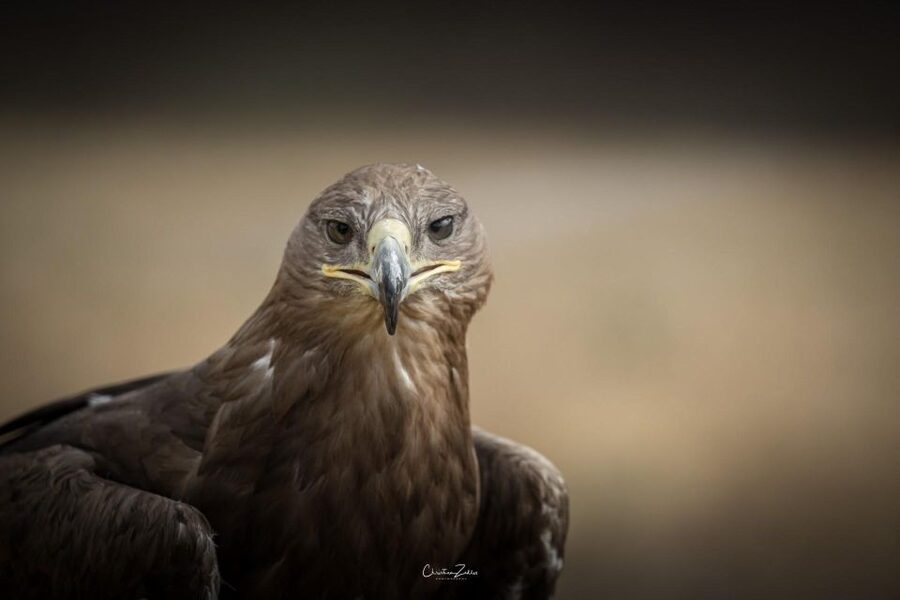
At $90.51 per person, this is not a cheap add-on in the way a short viewpoint stop or a casual farm visit might be. It is a specialized private activity with an animal trainer, two birds of prey, teaching in English or Italian, a falconer glove, and included photos and video.
I think the price is fair for the right person. You are paying for access to a carefully managed experience, not just admission to a place where birds happen to be present. The private group format is also important. It should give you better access to Davide and more room for questions than a large public demonstration.
The value is strongest if you care about the birds themselves. You will get more from the session if you want to understand falconry and animal behavior, rather than simply collect a quick photograph.
The cost may feel high for families, especially since children under 10 cannot join. It may also be less appealing if you are traveling on a very tight budget or have limited time in Tuscany. This is a special-interest activity, not a general introduction to the entire Val d’Orcia.
Free cancellation up to 24 hours before the activity and the option to reserve now and pay later reduce some booking risk. Even so, weather remains the practical concern. Keep part of your schedule flexible if possible, since rain may require a new date.
Who will enjoy this most?
I would recommend the experience to adults, older children, couples, families with children aged 10 and above, and anyone with a strong interest in birds or animal care. It also suits people who want a quiet rural activity between visits to Tuscan towns and wineries.
You will probably enjoy it most if you like asking questions. Davide’s explanations are central to the outing, and the experience rewards attention. The more interested you are in training, behavior, and the birds’ daily lives, the more satisfying the 1.5 hours should feel.
It is also a good match for visitors who prefer a small private group over a large organized tour. You can focus on the birds, the trainer, and the views without the feel of a crowded attraction.
I would be cautious about booking it for anyone who dislikes outdoor activities, has mobility limitations, or wants a guaranteed schedule regardless of weather. The session takes place outside, and the birds’ flights must be handled according to suitable conditions.
Bring your patience and your curiosity. Food and drinks are not allowed, and pets are not allowed, so plan accordingly before you arrive.
Practical details for planning your day
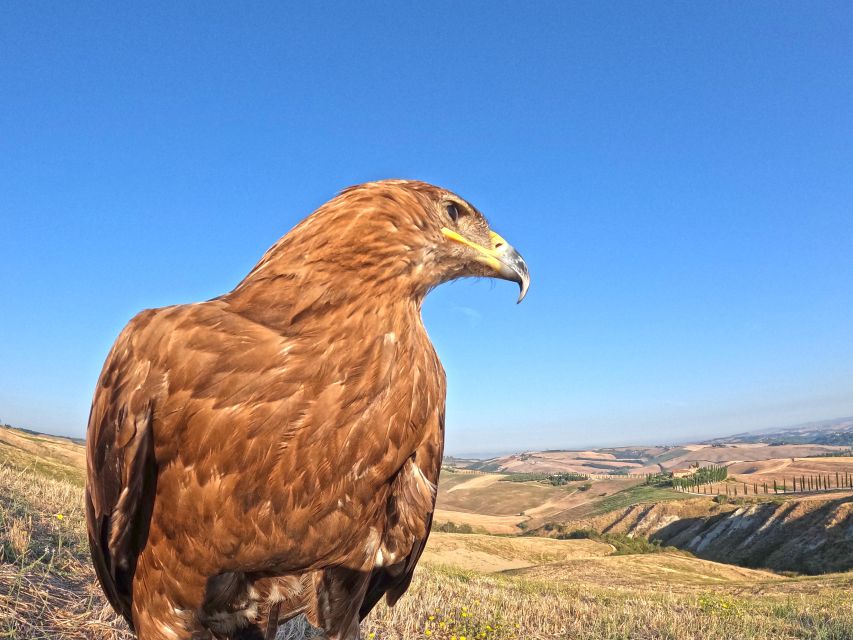
The activity lasts about 1.5 hours. Starting times are listed according to availability, generally in the 10:00 to 16:00 range. Since the location is in the Crete Senesi area of Val d’Orcia, allow enough time around the appointment if you are driving between countryside sights.
The experience is offered every day of the year in favorable weather. That does not mean every date is guaranteed to run exactly as planned. If rain is expected, the booking may need to move to another day.
Instruction is available in English and Italian. This is important because the teaching is a meaningful part of the session, not a minor extra.
The minimum age is 10. The activity is not suitable for people with mobility impairments, and pets are not permitted. Food and drinks are also not allowed during the experience.
Should you book the birds of prey experience?
Book it if you want an intimate encounter with trained birds, a clear introduction to falconry, and a memorable setting in the Crete Senesi. Brave the Harris’s buzzard and Ivy the Asian steppe eagle give the session real character, while Davide’s teaching explains the care behind each flight.
Skip it if your schedule cannot handle a weather change, if you want a broad sightseeing tour, or if $90.51 feels too much for a 1.5-hour activity. For bird lovers and curious families with older children, though, this is a strong choice. You get close to the animals, learn how the bond with the trainer works, and leave with photos, video, and a better sense of why falconry has lasted so long.
FAQ
Where does the birds of prey experience take place?
The meeting point is in the Crete Senesi area of Val d’Orcia in Tuscany, central Italy. The activity includes panoramic countryside views.
How long does the experience last?
The activity lasts about 1.5 hours. Available starting times generally fall between 10:00 and 16:00.
Which birds will I see?
The experience includes Brave, a Harris’s buzzard, and Ivy, an Asian steppe eagle. Native or migrating wild birds may also appear, but sightings are not guaranteed.
Is the activity available in English?
Yes. The instructor and animal trainer, Davide, provide the experience in Italian or English.
Can children join the falconry experience?
Children under 10 are not permitted. The activity is also not suitable for people with mobility impairments.
What happens if it rains?
The experience runs in favorable weather conditions and does not take place in the rain. If the forecast requires it, the booking date may be changed.
Newest birding reviews around Italy
- Lio Piccolo: Flamingos & Birdwatching Bike Tour in the Lagoon★ 5.0 · 7 reviews
- Falconry experience in Tuscany★ 5.0 · 24 reviews
- Vendicari – Sicily’s best coast nature reserve ( Birdwatching & Archeology )★ 5.0 · 8 reviews
- Birdwatching at Saline Maria Stella in Trapani★ 5.0 · 3 reviews
- Vendicari private visit 3 hours The Bird Hotel.★ 5.0 · 2 reviews
- Combo: Cagliari Old Town and the Oasis of Flamingos★ 5.0 · 22 reviews
- Matera: Handmade Clay Bird Workshop★ 5.0 · 4 reviews
- Cagliari: EcoSafari Flamingos Tour in Molentargius Park★ 4.5 · 17 reviews
Birds of Prey & Falconry, side by side.
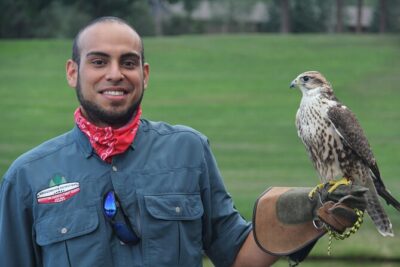
Colorado Springs Hands-On Falconry Class and Demonstration
Read our review →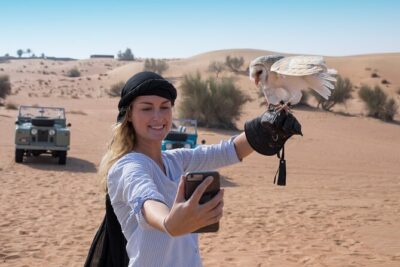
Morning Falconry & Nature Desert Safari with Transfers from Dubai
Read our review →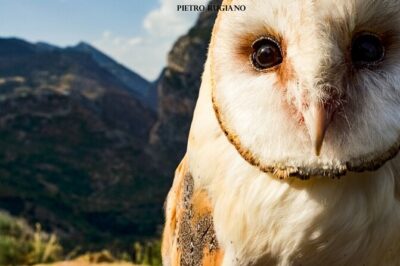
Interactive Educational Course on Birds of Prey
Read our review →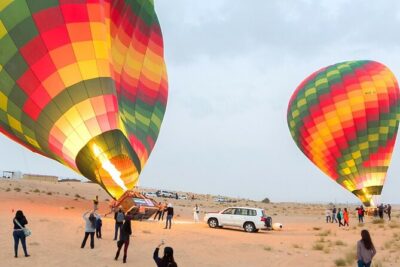
Dubai Hot Air Balloon Ride with Breakfast, Falconry & Camel Ride
Read our review →
Margaret River: Birds of Prey Encounter and Forest Walk
Read our review →Lists this trip turns up in