
REVIEW · JAPAN
Nara Todaiji Lazy Bird Walking Tour
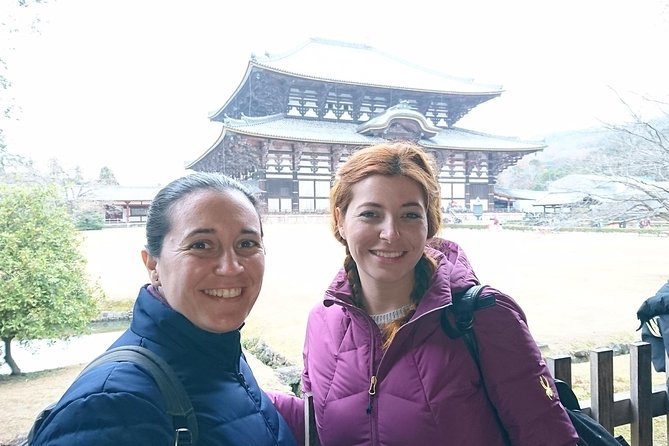
Nara’s magic comes quickly: deer wander through the park while huge wooden temple halls rise beyond them. This private four-hour walk takes you from Nara Station to Todai-ji, Kasuga Grand Shrine, and Kofuku-ji without asking you to sort out the route on your own. The Great Buddha Hall is the showstopper, but the quieter climb to Nigatsu-do may be the tour’s best surprise.
I like the way the route mixes major sights with smaller stops, and I like having a guide explain how Shinto and Buddhism share this old capital. Guides such as Noriko, Yuka, Masa, Emi, and Shigeyuki have earned praise for clear English, patience, and adjusting the pace for families. The main drawback is simple: this is a walking tour with several temple areas, steps, and uneven stretches, so four hours may feel demanding if you have mobility limits.
Key points at a glance
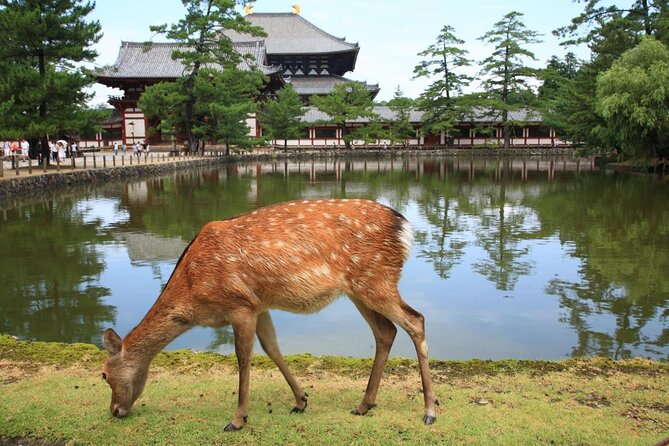
- Feed Nara’s free-roaming deer: You can buy crackers and hand-feed the semi-tame deer in Nara Park.
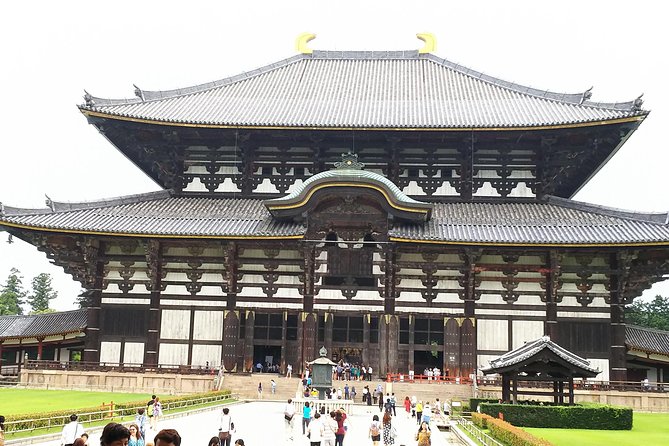
- See Todai-ji’s Great Buddha Hall: The world’s largest wooden building makes the central temple visit hard to forget.
- Reach Nigatsu-do’s city view: A short climb brings you to a wooden terrace that many visitors skip.
- Combine temples and shrines: The route includes Todai-ji, Hokke-do, Kasuga Grand Shrine, and Kofuku-ji.
- Keep the group private: Only your own party participates, with a guide leading the way.
- Fit Nara into a tight schedule: The four-hour format works well for a Kyoto to Osaka day when time is limited.
Why this four-hour Nara walk works
This tour is built for seeing a lot without turning Nara into a puzzle of station exits, temple grounds, and forest paths. You meet at Nara Station at 2 pm, then walk through the main sights before returning to the same meeting point.
That timing gives you a half-day in Nara rather than a full-day commitment. The city is about a 30-minute train ride from Kyoto, so this can fit neatly into a larger Kansai plan. One particularly useful feature is the private format. You are not waiting for a large group to gather at every gate, and your guide can respond to the needs of your own party.
The listed price is $86.49 per person. That covers the guide, but not everything else. You should budget another ¥800 per person for admission fees, ¥460 for public transportation, and extra money for food, drinks, and optional deer crackers. That makes the tour less cheap than a self-guided visit, but the value is in the route, explanations, and time saved.
If you already know Nara well and enjoy finding your own way, you may prefer to pay only the entrance fees. If you have one afternoon and want the major sights arranged in a sensible order, the added cost is easier to justify.
A few more birding trips around the world worth a look
- Penguin Parade, & Wildlife Encounters Eco Tour from Melbourne
★ 5.0 · 3,774 reviews - Cape Town: Cape of Good Hope & Penguins Day Tour with Pickup
★ 4.7 · 3,362 reviews - Cape Point and Boulder’s Penguins Full Day Tour
★ 5.0 · 3,118 reviews
Meeting the deer in Nara Park
Nara Park is the gentle opening act. Hundreds of deer roam freely here, moving between people, trees, shrine approaches, and temple grounds. They are semi-tame, not stuffed toys with hooves, so you should treat them with care and follow your guide’s instructions.
You have about 30 minutes for the park and for photographs. You can choose to buy deer crackers and offer them by hand. The deer often follow people who appear to be carrying food, which creates plenty of memorable moments but can also make the feeding area feel busy.
Your guide can help you approach the deer sensibly and may point out which animals are calmer. One past visitor especially appreciated being introduced to friendlier deer by Masa. That sort of small judgment is useful, especially for families with children.
Keep your hands empty after the crackers are gone, and do not assume every deer wants to be touched. The park is free to enter, so this first stop gives you the classic Nara scene without using any of your entrance-fee budget.
Nigatsu-do and the view most people miss
From Nara Park, the walk continues to Nigatsu-do Hall, part of the Todai-ji temple grounds. The hall is known for its wooden terrace and the lanterns hanging from the roof. From here, you can look across Nara city.
The tour allows about 20 minutes at this stop. That is enough for photographs and a short explanation, though not enough for a long pause. The walk up can be tiring for some people, particularly after time spent on foot in the park.
This is one of the route’s smartest choices. Todai-ji’s Great Buddha Hall gets nearly all the attention, while Nigatsu-do offers a quieter view and a better sense of the temple complex’s setting. If you want a photo that shows more than a famous doorway, this is the place to take it.
Wear shoes with good grip. Comfortable footwear is not a minor suggestion here. You will be walking between several large sites, and the route includes an uphill section to the terrace.
Hokke-do, the oldest building in the Todai-ji grounds
Hokke-do Hall gives the tour a more intimate stop after the broad view from Nigatsu-do. It is described as the oldest building on the Todai-ji grounds, and its 8th-century Buddhist statues are the main reason to visit.
You have roughly 30 minutes here. Admission is not included, so the additional ¥800 listed for temple entries matters at this point and at the Great Buddha Hall. The fee is modest, but you should know about it before arriving so the advertised tour price does not come as a surprise.
The appeal of Hokke-do is its age and the character of the objects inside. The statues were created in a distinctive style, and a guide can give you a better frame for understanding them than a quick solo look at a sign. If your interest is mainly in grand buildings and outdoor photographs, this stop may feel slower. If you want more than a checklist of famous views, it adds substance.
Same hide, a different set of birds:
- Cape of Good Hope & Boulder Penguins Full-Day Tour from Cape Town
★ 5.0 · 2,347 reviews - From Melbourne: Penguin Parade, Koalas & Kangaroos
★ 4.5 · 1,932 reviews - Table Mountain, Penguins & Cape Point Small Group Tour Cape Town
★ 4.5 · 1,797 reviews - Cape Town Tour: Table Mountain, Penguins & Cape Point+Pickup
★ 4.7 · 1,671 reviews
Entering Todai-ji’s Great Buddha Hall
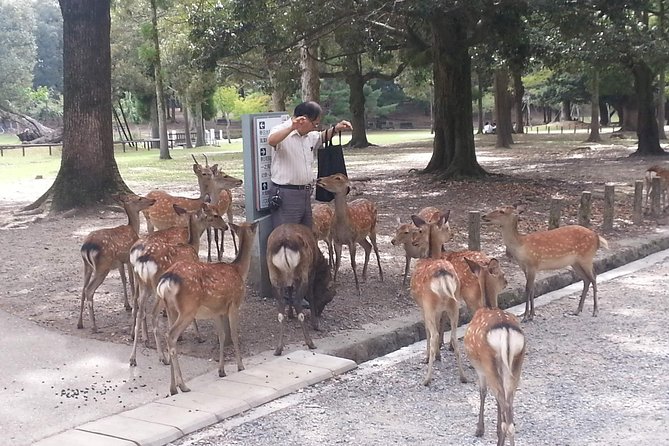
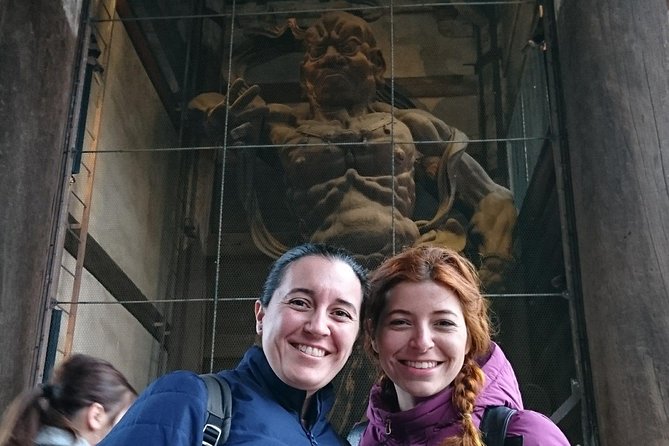
The main event is Daibutsuden, the Great Buddha Hall at Todai-ji. You approach through the temple grounds, often among the deer, before the scale of the hall comes into view. The building is presented as the world’s largest wooden building, and its size is impressive even before you step inside.
The visit lasts about 45 minutes. That is the longest stop on the route, and rightly so. The hall holds the Great Buddha, one of Nara’s defining sights, along with the massive timber construction that makes the building itself part of the spectacle.
Admission is not included. The tour information lists ¥800 per person in entrance fees, so plan to pay this in addition to the tour price. Your guide can help you understand the religious meaning of the hall and the relationship between the Buddha, the temple, and Nara’s early importance.
This is also the stop most likely to feel crowded. The approach is a major visitor route, and the building is one of Japan’s best-known temple sights. A guide cannot remove the crowds, but a private guide can keep the visit focused and help you use the limited time well.
A forest walk to Kasuga Grand Shrine
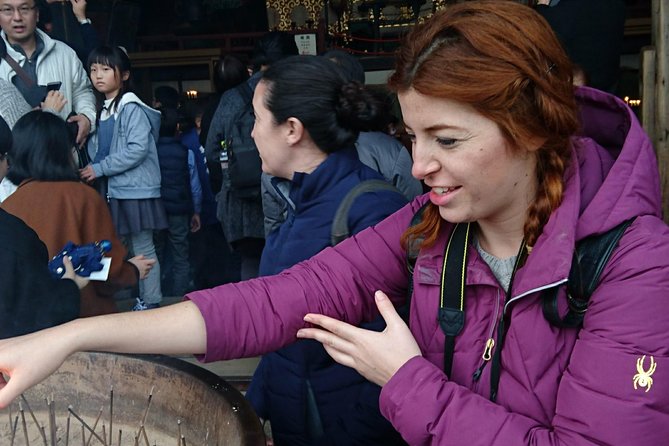
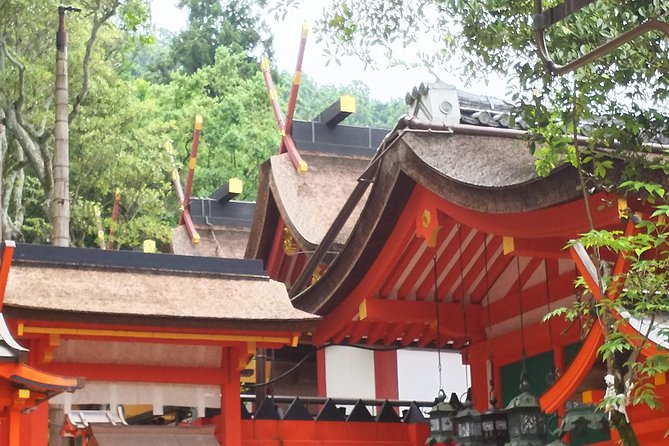
After Todai-ji, the route shifts from giant architecture to a quieter forest setting around Kasuga Grand Shrine. You will see bright vermilion buildings, old stone lanterns, and hanging lanterns along the shrine grounds.
The tour allows about 30 minutes here. That is enough for a pleasant walk and photographs, though it is not a full exploration of every part of the shrine. The change of mood is welcome after the scale and activity around Todai-ji.
Kasuga Grand Shrine also helps show that Nara is not only about Buddhist temples. The route gives you a chance to compare shrine spaces with temple spaces and to ask your guide about Shinto practices. Several people particularly valued learning about the differences and connections between Shinto and Buddhism during the walk.
The forest path can be peaceful, but it adds more walking. If you are tired by this point, tell your guide. The private format gives your group more room to adjust than a fixed large-group outing.
A quick look at Kofuku-ji Temple
Kofuku-ji is the final major sight, with about 10 minutes set aside for the stop. Its five-storied pagoda is the visual anchor. The pagoda was built about 600 years ago and uses thick logs joined in a strong, dynamic construction.
Ten minutes is brief, so think of this as a final look rather than a full temple visit. You will have time for the pagoda and a short explanation, but not a leisurely tour of every building. That limited time is one reason the guide-led format helps. You can get the key context without spending another hour deciding what deserves attention.
The route then returns to the Nara Station meeting point. Since the tour begins and ends there, you can continue by train afterward without arranging a separate pickup.
Guides, pace, and family fit
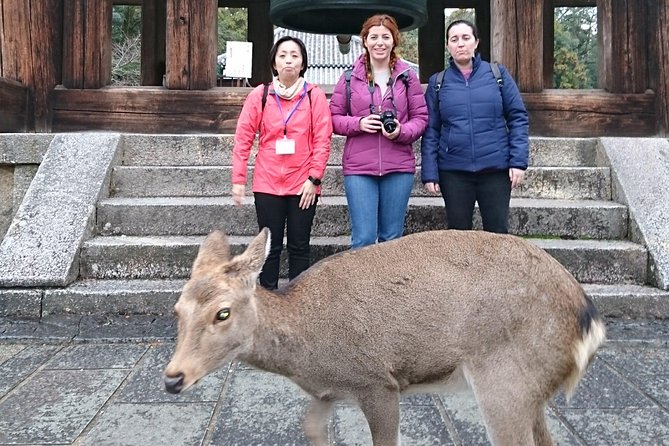
The strongest feature of this experience is the guide service. Yuka has been praised for patience with a 10-year-old and for covering a large part of Nara without making the family feel rushed. Noriko has received particular praise for her English and for keeping the itinerary at a comfortable pace.
Masa is noted for being friendly, communicative, and helpful with the deer. Emi is described as kind and well informed about Todai-ji. Shigeyuki has been praised for making a great deal of Nara fit into four hours while keeping the afternoon enjoyable.
These details matter because a walking tour can feel very different depending on the person leading it. The experience has a perfect five-star rating from 11 reviews, with 100 percent recommending it, but the useful takeaway is not just the number. The repeated themes are clear English, thoughtful pacing, local sights beyond the obvious stops, and a willingness to adapt.
The tour is listed as private, so only your group participates. That suits families, couples, and small groups who want to ask questions freely. It also helps if your group has different energy levels. You should still be ready to walk at a moderate level, since the route covers a lot of ground in four hours.
What the afternoon does not include
The guide fee does not cover food or drinks. There is no meal built into the schedule, so eat beforehand or plan to find something after the tour. A 2 pm start can work well after lunch, but you should not count on a long restaurant break during the walk.
Public transportation is also extra, listed at ¥460 per person. The exact role of that fare is not detailed, so keep the amount in mind as part of the total cost. Temple admission is listed separately at ¥800 per person.
The tour requires good weather. If poor weather causes cancellation, you will be offered another date or a full refund. You can cancel for a full refund up to 24 hours before the start time, but changes or cancellations inside that window are not accepted.
Animals and pets are allowed according to the tour information, though the deer are the main animal encounter. If you bring a pet, remember that the route includes temple and shrine grounds as well as areas with free-roaming deer.
Who should book this Nara tour
I would choose this tour if you have only half a day, want help with the route, or prefer learning as you go rather than reading signs on your own. It is especially useful for first-time visitors coming from Kyoto, families with older children, and people who want to combine deer, temples, a shrine, and a city view in one outing.
It is also a good match for anyone who values a private guide. You can ask about Buddhist statues at Hokke-do, the meaning of the Great Buddha, or the difference between a shrine and a temple without holding up a large group.
I would think twice if you have limited mobility or dislike walking for several hours. The itinerary is full, and one past visitor specifically noted that it may not suit people with mobility issues, though the guide may be able to adjust the route. Contact the provider before booking if this is a concern.
I would also skip it if you want a slow, unstructured day. The schedule gives each place a set amount of time, and the Kofuku-ji stop is particularly short. This is a focused introduction, not an all-day study of every temple in Nara.
Should you book the Nara Todaiji Lazy Bird Walking Tour?
Book it if you want an efficient, private introduction to Nara with a human guide leading the way. The best parts are the mix of famous and quieter sights, the chance to feed the deer, the Nigatsu-do view, and the clear attention to family pacing.
At $86.49 per person, plus ¥800 admission and ¥460 transportation, it is not the lowest-cost way to visit Nara. But for a four-hour private route that includes Todai-ji, Kasuga Grand Shrine, Kofuku-ji, and several smaller stops, it offers a fair trade: less planning, fewer wrong turns, and more context.
FAQ
Where does the tour begin?
The tour begins at Nara Station, at 1 Sanjohonmachi, Nara, 630-8122, Japan.
What time does the tour start?
The start time is 2 pm.
How long does the tour last?
The tour lasts approximately four hours.
Where does the tour end?
The activity ends back at the meeting point at Nara Station.
Is this a private tour?
Yes. Only your own group participates in the activity.
Are temple admission fees included?
No. Admission fees are listed separately at ¥800 per person.
Is transportation included?
No. Public transportation costs are listed separately at ¥460 per person.
Can I cancel for a full refund?
Yes. You can cancel at least 24 hours before the start time for a full refund. If poor weather causes the tour to be canceled, you will be offered another date or a full refund.
Newest birding reviews around the world
- Walvis Bay Shore Excursion: Flamingos, Dune 7, Swakopmund★ 5.0 · 3 reviews
- VIP falconry taster session★ 5.0 · 2 reviews
- Vila Franca do Campo: Marine Life & Bird Watching & Islet Tour★ 4.4 · 9 reviews
- York: Entry to York bird of prey centre★ 5.0 · 7 reviews
- Vestmannaeyjar: Puffin, Island, and Volcano Boat Tour★ 4.4 · 7 reviews
- Visit to Madeira Bird Island★ 4.6 · 22 reviews
- Ushuaia: Gable Island and Penguin Colony with Lunch★ 4.8 · 2 reviews
- USHUAIA | Navigation: Sea Lions, Birds and Lighthouse★ 3.3 · 4 reviews
Japan Birdwatching Tours, side by side.

Sapporo Winter : Asahiyama Zoo (Penguin Fun & Snowmobile)
Read our review →
Wild Bird Sanctuary Forest Guided Tour in Nagano
Read our review →
Penguin Fun & Snowmobile : Sapporo Winter (Asahiyama Zoo)
Read our review →
Lists this trip turns up in